
This toolkit focuses on improving the quality of monitoring and evaluation (M&E) of projects when planning to evaluate outcomes and impacts.
Whilst its stated focus is on small and medium sized projects, it could equally be applied to large projects. Similarly, it can be used when planning, implementing or analyzing and adapting projects.
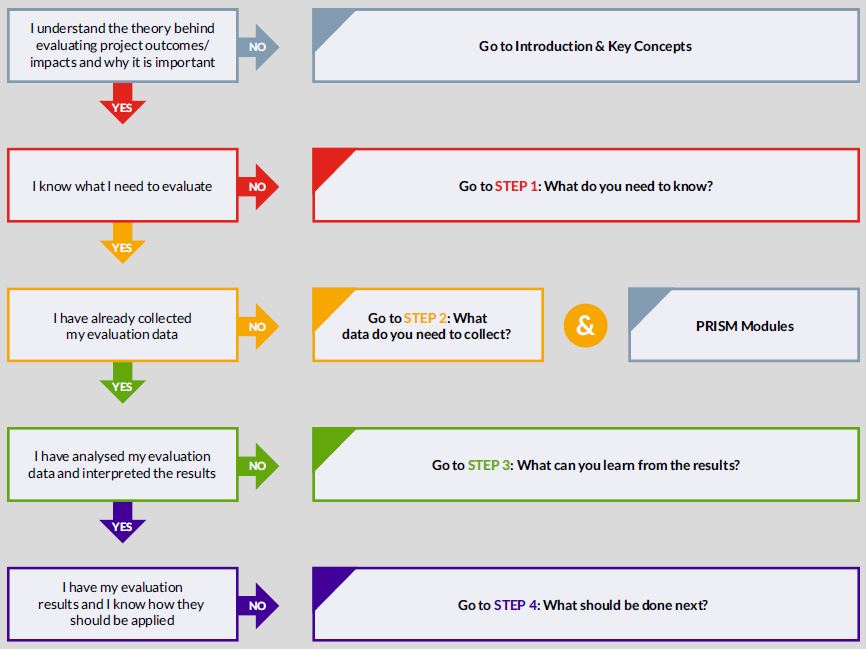
Decision tree to navigate through the PRISM toolkit
The document clearly highlights the main considerations in doing an evaluation (and even whether you should evaluate), and further identifies a range of M&E tools useful for a variety of different conservation strategies. Its three sections:
- outlines some of the key concepts relating to evaluation of outcomes and impacts
- provides a step-by-step process for evaluating project outcomes and impacts
- provides detailed guidance and methods to measure outcomes and impacts relating to five thematic modules, each one covering a different category of conservation action.
It is a very good resource, albeit with room for improvement and clarification in a few areas. In particular some concepts and terms could be better categorized to avoid confusion. For example when categorising potential evaluation designs (table, pg 53), the approaches noted are not mutually exclusive.
Citation: Dickson, I. M., Butchart, S. H. M., Dauncey, V., Hughes, J., Jefferson, R., Merriman, J. C., Munroe, R., Pearce-Higgins, J. P., Stephenson, P. J., Sutherland, W. J., Thomas, D. H. L., & Trevelyan, R. (2017)
PRISM: TOOLKIT FOR EVALUATING THE OUTCOMES AND IMPACTS OF SMALL/MEDIUM-SIZED CONSERVATION PROJECTS. www.conservationevaluation.org

One Response to “PRISM: Toolkit for Evaluating Outcomes and Impacts (2017)”
Endalamaw Yihune
Indicators:
Indicator: Number of local bylaws or regulations formally adopted and enforced by communities/local authorities for Echinops kebericho conservation.
Explanation: This indicator measures the concrete output of efforts to establish formal rules at the local level. It reflects the success in engaging communities and local governance structures to create binding agreements that can regulate harvesting, protect habitats, and promote sustainable use. Enforcement demonstrates the practical application and acceptance of these rules.
Indicator: Number of regional or national policy documents (e.g., biodiversity strategies, protected area management plans, medicinal plant policies) that explicitly incorporate Echinops kebericho as a critically endangered species and include specific conservation measures.
Explanation: This indicator assesses the project’s success in influencing higher-level policy. It shows that Echinops kebericho conservation is not just a local initiative but is recognized and integrated into broader governmental frameworks, which can unlock wider support, resources, and legal protection for the species.
Indicator: Percentage increase in awareness among surveyed community members (including harvesters and traditional healers) regarding the critically endangered status of Echinops kebericho and the importance of its sustainable use.
Explanation: This indicator directly measures the impact of awareness campaigns on the target audience’s knowledge. By conducting pre- and post-campaign surveys, the project can quantify the change in understanding, attitudes, and reported practices, indicating whether the information disseminated is effectively reaching and influencing key stakeholders.