
Effective conservation requires a shared language to identify and assess threats to ecosystems and species. Since 2008, the IUCN Species Survival Commission and Conservation Measures Partnership have maintained a unified Threats Classification to guide planning, action, and learning. Now, with input from thousands of projects and users, Version 4.0 is here and introduces refined categories, new threat types, and detailed modifiers for deeper analyses. Read more about this work in Conservation Biology here.
This update enhances how practitioners address challenges like climate change, invasive species, and human impact—empowering more precise, impactful conservation efforts worldwide.
Access the IUCN – CMP Threats Classification 4.0 here.
Read more about this work in Conservation Biology here.
We are grateful to our colleagues at the Canadian Wildlife Service (CWS) for providing this French translation of the IUCN-CMP Threats Classification v4.0; while it represents a community-contributed version rather than an officially ratified global translation, we are pleased to make it accessible to the Conservation Standards community and welcome any further feedback from French-speaking practitioners.
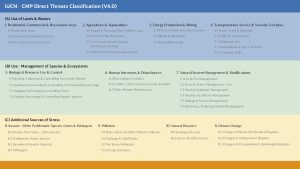
What is new in version 4.0?
- New Level 0 Threat Classes
- Revisions to Level 1 Threat Names
- Additions & Mergers of Level 2 Threats
- Addition of Systematic Level 3 & 4 Threats Types
Criteria for the Ideal Direct Threats Classification
There is no one “right” classification system. Instead, we attempted to develop a system that optimizes the following criteria: Useful, Simple, Hierarchical, Comprehensive, Consistent, Expandable, Exclusive, and Scalable.
Where is Version 3.0?
The threat classification system, initially developed in the early 2000s, was first released as Version 1.0 by IUCN and CMP in 2007, with minor updates in Version 1.1. Recognized as an international standard, updates have been carefully timed to balance stability with the integration of new knowledge.
In 2013, CMP released Version 2.0, which was reviewed but not formally adopted by the IUCN Red List. The IUCN independently updated their classification to Version 3.3 by 2022.
Starting in 2022, IUCN and CMP collaborated on a joint task force to unify and enhance the classification, culminating in Version 4.0. This latest version consolidates improvements and aligns previous iterations, with earlier versions remaining valid for use. Detailed “track changes” show edits from CMP Version 2.0.
